LED Strips, Cheaper vs. Cooler
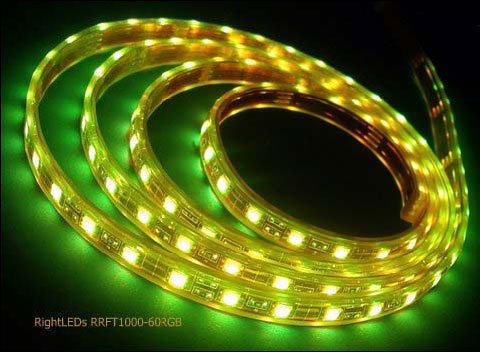 LED strips are growing in popularity and ease of use. I’ve been playing around with them lately (with my Arduino), and, for the uninitiated, here’s an overview of what’s available, and how much it costs.
Introduction The strips are flexible ribbons of PCB material, with LEDs periodically fixed on them. They come in two basic varieties: addressable and non-addressable. With an addressable strip, you can control each individual light independently, but with a non-addressable strip you control the whole strip together.
Addressable Strips These are the cool ones. You can individually control each pixel, and can program some cool effects. I haven’t seen many projects using these, though. There are two different versions that I know of: LPD8806 & HL1606. Both use RGB LEDs, which let you display a variety of colors.
Addressable Strips: LPD8806 These are awesome. They have built-in pulse-width modulation (PWM), which gives you access to more colors than are differentiatable by the human eye (7-bits for each Red/Green/Blue). These are the priciest at $30 per meter (if you buy 5 meters). You can pick some up at adafruit. In the video, you can see that there is a gradual transition between the colors.
Addressable Strips: HL1606 These are not as cool as the LPD8806, because they don’t have built-in PWM. You can do some manual (CPU-intensive) hacking to get it to work, but without that you are limited to 1 bit for each channel (so 8 colors total). The big win here is that you can get it cheaper (around $20 per meter, on ebay). In this video, you can see that there’s a much rougher transition between colors, because you don’t have as many to play with.
Non-Addressable I’d imagine these are good for car effects, under-cabinet lighting, and similar projects. These are two basic types that I know of: RGB and single-color. You can get some RGB ones at adafruit ($25 per meter). I haven’t picked up any single-color ones, but it looks to be around $5 per meter.